
Role Playing for GMs
"Brother, listen to me! The Dungeon is my character!" -Brad Kerr

3x5 Arcana’s blog has moved.
View this post in its new home:
I’ve worked on stage as a professional actor for upwards of 20 years. This is what I have to say about compelling role-playing for RPGs.
It’s not about doing voices! It’s not about pretending to have feelings!
Two Questions
In very large part, acting (and roleplaying) is answering two questions.
What does this character want?
What does this character believe?
When you’ve answered them, you will have specific and compelling answers to the question you must face over and over again
What does this character do?
I present to you role-playing tools boiled down from Stanislavski, Uta Hagen, and a life lived in a Shakespeare Cult — into an index-card sized reference tool. One that won’t make anyone embarrassed or uncomfortable.
This is also how I designed NPCs for my upcoming adventure, The Spear of Horrendous Iron (which just funded on Kickstarter).
People are their actions.
Mannerisms do not make compelling characters that drive story, actions do.
Playing a wicked character means making them do wicked things.
Playing a naïve character means making them do naïve things.
Action is applied desire.
What a person does is an expression of what they want. Not enough attention is paid to this in RPGs! Very often, adventures will give you guidance on what someone does. Such as:
The Dwarf will offer news in exchange for gold.
The Kobold will run away if attacked.
The Wizard will fight to protect her library.
But they won’t often give you guidance on what someone wants. Such as:
The Dwarf wants to finance their journey home.
The Kobold wants to be gloriously eaten by his master.
The Wizard wants to live forever.
Or, equally…
The Dwarf wants respect.
The Kobold wants to bring his master fresh meat.
The Wizard wants to hide the awful secrets she possesses.
Or…
The Dwarf wants to be the richest being in 500 miles.
The Kobold wants to be an artist.
The Wizard wants to teach nonviolence.
Each of these wants is compatible with the actions prescribed. But each of them presents a very different character.
The answer to the question: What does this person want? is the razor which cuts the Gordian knot.
What do they want? The Actor’s First Question.
The question comes from Stanislavski. You sort out why your character doesn’t walk offstage, why they’re willing to undergo the risk of being in the play. What is your objective?
Games, of course, are different from plays.
In a play, you know what your character does, and you’re trying to animate those actions as convincingly and meaningfully as possible by identifying the most compelling and personal thing for them to want. Their objective.
In a game, the question is even more necessary. You’re writing the story in real time. It’s not only a question of making something compelling, it’s a question of making it up to begin with.
What does Marian want? (Example.)
Let’s take a peasant. We’ll call her Marian.
Let’s say tax collectors roll into the town square. Let’s say they’re bad, violent news, these guys. And let’s say our peasant, Marian, is there, drawing water from the well. The characters are hanging back, eating Cheetos, enjoying wathcing you do your GM-dance for them until they decide to do something.
What does Marian do? Usually, modules give you broad strokes - it might say that the peasants really don’t like the situation. But that’s not really enough to go on, is it? It’s not enough to tell you what she does, specifically.
So let’s give her something she wants. Something specific. Here are some things she might want:
The tax collectors to rot in hell.
To protect her friends in the weaver’s guild.
To prove herself.
To leave this awful place as soon as possible.
It is not until we know what she wants that we can act on her behalf. No amount of “this one has a raspy voice” is going to sort this out for you. If she wants something specific, she will do something specific. And that’s what makes worlds feel lived in and meaningful.
Let’s say she wants to prove herself. I like that one best.
Maybe this inspires us to drill down a bit. Prove herself. To whom?
Let’s say the blacksmith’s apprentice. (Maybe there’s a rivalry? Maybe there’s a romance?)
So we know what she wants: to prove herself. But what will she do? Attack? Make a speech? Bravely delay them while others escape?
Some context missing from our picture: what she believes.
What do they believe? The Actor’s Second Question.
When does an NPC interrupt the characters? Offer help? Attack? Snivel and retreat? Lie to the PCs? Or steal from them? Or die for them? What deal do they offer? What deal do they refuse? And why?
What you believe colors and instructs everything you do. It’s what actors ask themselves — to inform what they are trying to achieve with how they will go about it. This is what actors refer to as point of view. Uta Hagen, arguably, defined it in Respect for Acting.
Do they believe…
they are the most powerful being in 500 miles?
only the good die young?
humans are a stain on creation?
family above all?
they’re a born leader, surrounded by idiots?
The difference between the Sheriff of Nottingham and Robin Hood is one of beliefs. They both want the same thing: justice. The Sheriff believes in the divine right of Kings. Robin Hood believes in the right of people to eat.
What does Marian believe? (Example.)
So let’s give Marian a specific belief. Here are some things she might believe:
Everyone is good, deep down.
Violence is at best a broken tool.
Her god won’t let this happen.
If you die in battle, you live forever.
Let’s say she wants to prove herself to the blacksmith’s apprentice, and she believes that violence is at best a broken tool.
Now we have a foothold. Immediately, surprising and specific actions start to make sense. To prove herself and avert violence, she might
Assert a well-studied legal right to a delay in collection
Offer herself as a substitute for the taxes (Horrifying!)
Point at the PCs and loudly proclaim “These are treasure hunters. They’ve promised to return in two days with all the taxes this town owes. I’m leading them.”
Whatever she does, it’s bound to make the world more specific, and more moving.
Using this Method
For every NPC you play, ask:
What do they want?
What do they believe?
And let the question of what they do emerge from play.
The process is simple. Just write the NPCs’ names on an index card. Next to each one, write what they want, and what they believe. The skill involved is to pick simple, interesting and game-able desires and beliefs: ones that will
motivate action
reveal something
offer the players choices with consequences
Here’s how I do that:
Wants
Stick with simple, human-things:
I want to be loved
I want to feel safe
I want to prove myself.
That sort of thing.
Beliefs
Pick something that specifically has a bearing on the adventure (in our example, violent tax collectors / violence is a broken tool).
If your adventure is about sickness, pick beliefs about medicine.
If your adventure is about war, pick beliefs about the war.
If your adventure is about forbidden knowledge, pick beliefs about secrets.
Example In Action
Let’s return to Marian, and see how this kind of specific worldbuilding spirals outward from the humble answers to two tiny questions.
Our peasant wants to prove herself and believes that violence is at best a broken tool.
We are now way beyond “the peasants hate the tax collectors.”
We now have an evocative person who, if you put her in relationship to anything, provokes other questions. And we now have a vocabulary for answering them, as well.
She wants to prove herself.
To who? Let’s arbitrarily say…. the Blacksmith. Why does she want to prove herself to him?
Maybe… they’re siblings?
Maybe… they’re rivals?
Maybe… she loves him?
Why prove herself to the blacksmith?
Maybe… he has been making weapons to fight the tax collectors. Why?
Maybe… the Blacksmith maybe wants revenge, and believes that life isn’t worth living this way. feel safe
Now we have two very specific NPCs giving the players choices with consequences and a third is not hard to imagine. This is starting to look like a town with multiple NPCs that the players can interact with in different ways!
(These “maybes” I’ve provided can be wicked hard to come up with on the fly. Which is why you should have an index card table prepped.)
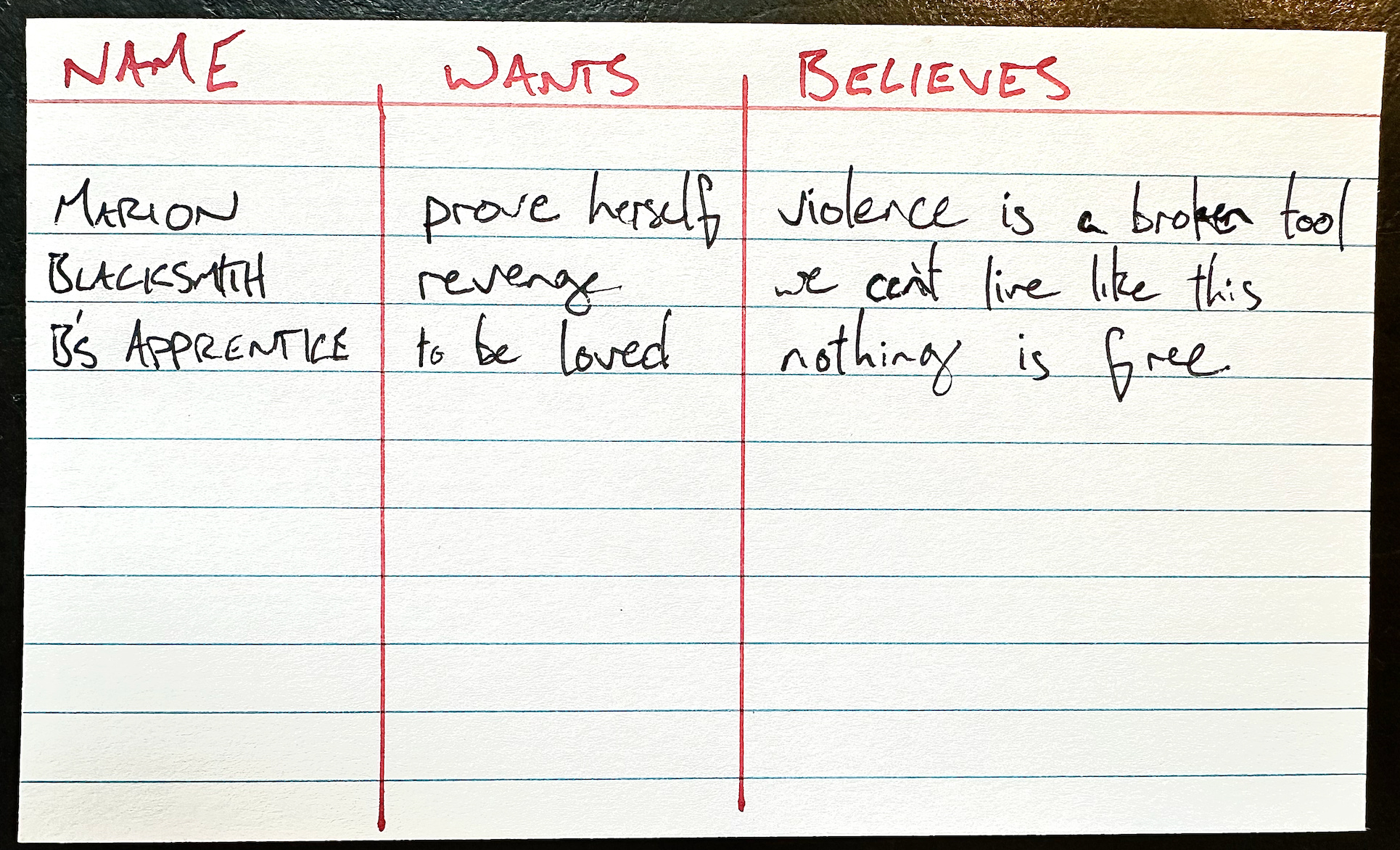
Today’s Index Card:
D10 Wants and Beliefs
Here are some generic wants and beliefs that will impr
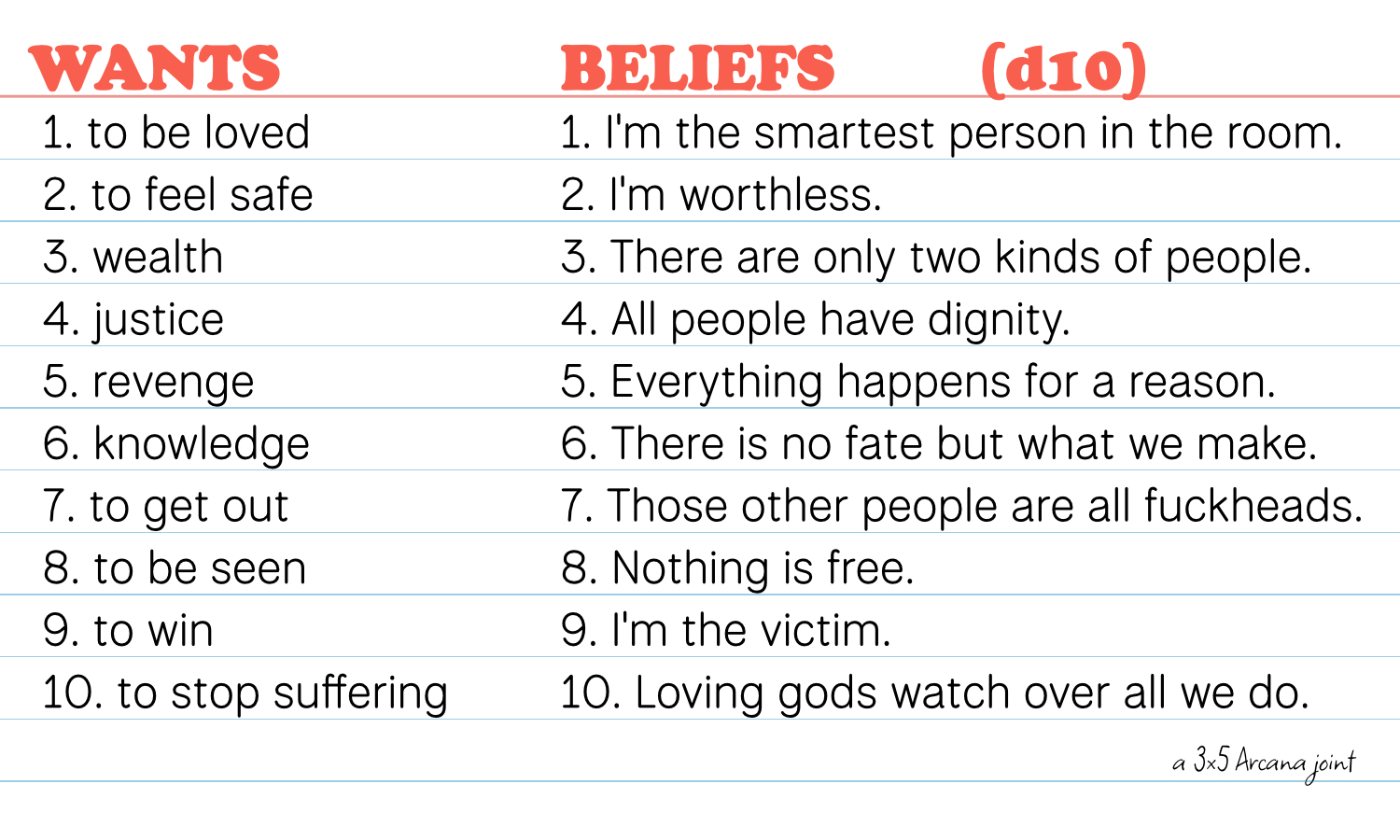

Of course, these beliefs are pretty generic. To create a specific sense of place, write a table of beliefs specific to the theme of your adventure! More on that in the next post.
Obligatory Plug
This theory is applied for you in my adventure, The Spear of Horrendous Iron. If you think this is for you, you’ll probably like the adventure! Check it out now on Kickstarter.
Excellent. I have been doing something similar. I pulled my version from reading screenwriting books and watching interviews on Film Courage. What I've used is Want(objectives)/ Obstacles/ Resources/ What are they doing to get what they want? The one piece I hadn't included was what do they believe. I will add that to my list. Nice piece, well written. https://grumpywizard.home.blog/2020/06/12/how-do-i-create-important-non-player-characters/
I love this! I've been looking for more ways to interweave acting principles and game mastering. You've codified it in a simple way that I'm looking forward to digging into!